Across Pakistan’s industrial hubs, from Karachi’s coastal humidity to the extreme 45°C+ heat of Lahore and Multan, cooling is not a luxury; it is the lifeblood of the economy.
While many businesses focus on compressors or control systems, the real performance of any HVAC system lies within its coils. Condenser coils, evaporator coils, chilled water coils, and steam coils are where actual heat transfer occurs. If the coil underperforms, the entire system becomes inefficient, unreliable, and costly to operate.
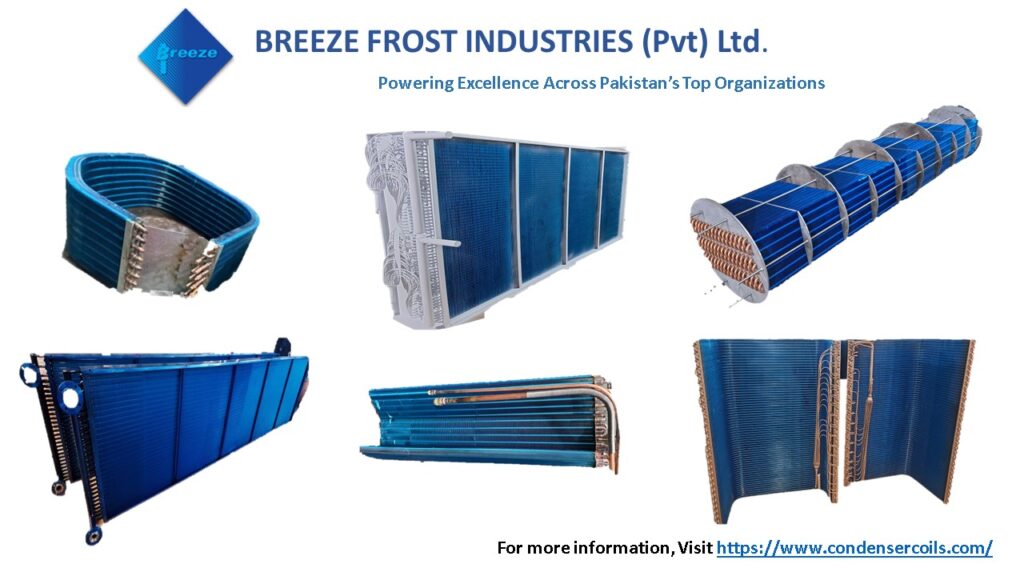
The 4 Essential HVAC Coil Types for Pakistan’s Industry
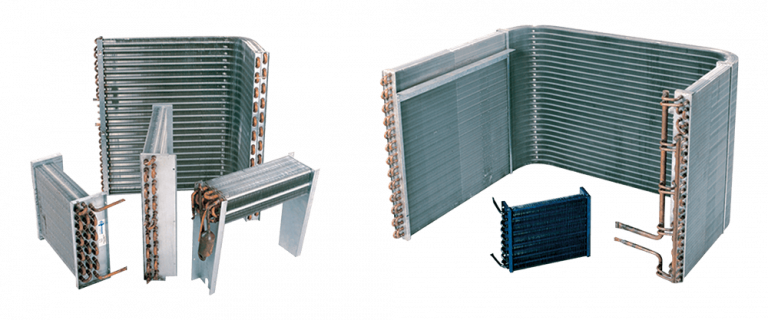
Condenser coils act as the “exhaust system” of HVAC units, releasing heat into the external environment. Most imported coils are designed for moderate climates and struggle in Pakistan’s extreme summer conditions. At Breeze Frost, we engineer condenser coils with optimized fin-per-inch (FPI) configurations and high-grade copper tubing, ensuring efficient heat rejection even at ambient temperatures exceeding 50°C.
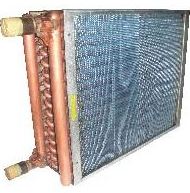
In monsoon-prone regions, humidity control is just as critical as cooling. Poor coil design can lead to moisture carry-over, reduced efficiency, and compromised indoor air quality. Our precision-engineered evaporator coils feature advanced circuiting to ensure effective dehumidification, making them ideal for pharmaceutical, healthcare, and cleanroom environments.
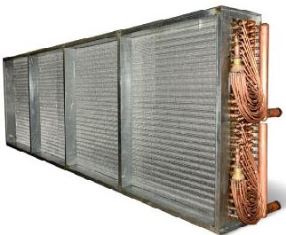
Chilled water coils are the backbone of centralized cooling systems used in hotels, hospitals, malls, and industrial facilities. Breeze Frost specializes in site-measured, custom-manufactured replacement coils, ensuring seamless installation in existing AHUs without structural modifications, saving both time and cost.
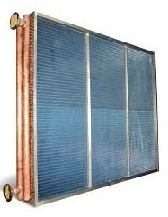
Steam coils are critical for textile processing, food production, and industrial heating systems. Operating under high pressure, these coils require robust engineering. We use heavy-gauge copper tubes and precision silver brazing to prevent steam hammer, leakage, and long-term failure.
The Economic Impact: Why Coil Quality Matters
With electricity prices at record highs in Pakistan, HVAC efficiency is no longer optional; it’s a business necessity. Even a thin layer of dust or corrosion (as little as 0.5mm) can reduce heat transfer efficiency by up to 20%, significantly increasing energy consumption.
Investing in high-performance coils leads to:
Lower electricity bills
Improved system lifespan
Reduced maintenance costs
In many cases, Breeze Frost solutions deliver a full return on investment (ROI) within six months through energy savings alone.
Imported HVAC solutions often fail under Pakistan’s harsh environmental conditions. With over 40 years of experience, Breeze Frost proves that locally engineered solutions outperform generic imports.
2. Faster Lead Times
Avoid long import delays. We deliver custom-built coils in significantly shorter timeframes.
Unlike foreign manufacturers, we offer direct, responsive support, ensuring long-term reliability and accountability.
Engineering Excellence Since 1983
With over four decades of expertise in thermal engineering and ISO 9001:2015 compliance, Breeze Frost Industries has earned the trust of leading organizations across Pakistan.
1. What is the function of a condenser coil in HVAC systems?
A condenser coil releases heat absorbed from inside a building to the outside environment. It plays a critical role in maintaining cooling efficiency, especially in high-temperature climates like Pakistan.
2. Why do imported HVAC coils fail in Pakistan?
Most imported coils are designed for moderate climates. In Pakistan’s extreme heat (often exceeding 45–50°C), they struggle with heat rejection, leading to inefficiency, higher energy consumption, and frequent breakdowns.
3. How often should HVAC coils be cleaned?
HVAC coils should be inspected every 3–6 months and cleaned regularly. Even minor dust buildup can reduce efficiency by up to 20%, increasing electricity costs.
4. What materials are best for HVAC coils?
High-quality copper tubing and aluminium fins are ideal due to their excellent heat transfer properties and durability in harsh environments.
5. What is fin-per-inch (FPI) in HVAC coils?
FPI refers to the number of fins per inch in a coil. It directly impacts heat transfer efficiency. Optimized FPI design ensures better performance in extreme climates like Pakistan.
6. Can HVAC coils be customized for existing systems?
Yes. Custom-designed coils based on site measurements can be manufactured to fit existing AHUs without structural changes, improving efficiency and reducing replacement costs.
7. How do HVAC coils affect electricity consumption?
Efficient coils improve heat transfer, reducing compressor workload and lowering energy consumption. Poor-quality or dirty coils significantly increase electricity usage.
8. How quickly can custom HVAC coils be manufactured in Pakistan?
Local manufacturers like Breeze Frost can design and deliver custom coils much faster than imported options, reducing downtime and operational losses.